Overtone
Gvh706rmjavhdtoday020050 Min Install Work <No Login>
I should ask for clarification on the code, but since I can't, I have to proceed with what's given. The report should include the interpretation of the timestamp, the 50-minute installation time, and note the code's ambiguity. Suggest verifying the code for accuracy. Also, structure the report with clear sections like overview, details, steps, issues, and next steps.
The user might be working on a technical support ticket or system install log, and wants to document the process. They might need sections like summary, installation steps, issues faced, conclusion. Since the code is unclear, the report should mention that as well. gvh706rmjavhdtoday020050 min install
Breaking it down: "gvh706rmjavhdtoday020050 min install". The part "today020050" could be a timestamp. "020050" might be February 05, 2020, or maybe 02:00:50 time. Then "min install" suggests something related to installation taking 50 minutes. I should ask for clarification on the code,
I wonder if the initial part is a code or identifier. Maybe it's a project or system code? "gvh706rmjavhdtoday" doesn't ring a bell. It could be a typo or a specific reference the user has. Maybe the user is trying to create a report about an installation that took 50 minutes, done at 2:05 AM (if 020050 is time). Or maybe the date is 2020. Also, structure the report with clear sections like
Examples
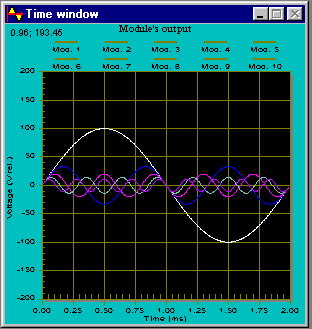
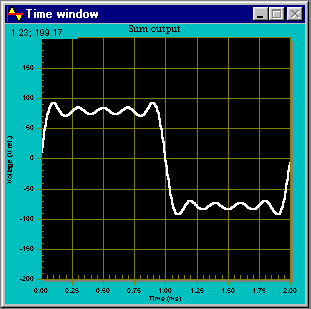
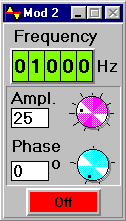
You can test the Helmholtz assumption that the relative phases of the overtones are irrelevant to hearing.
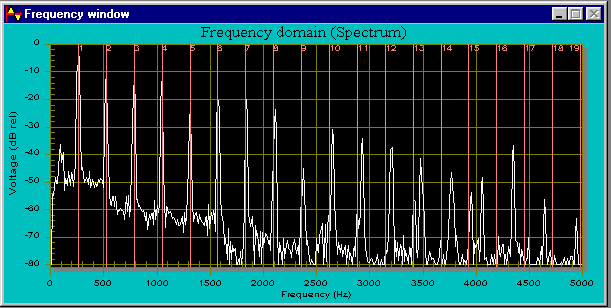
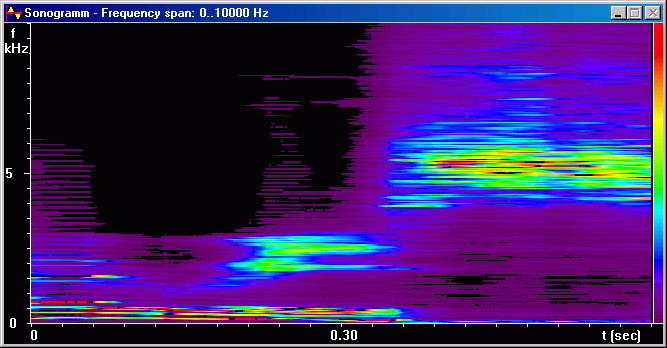
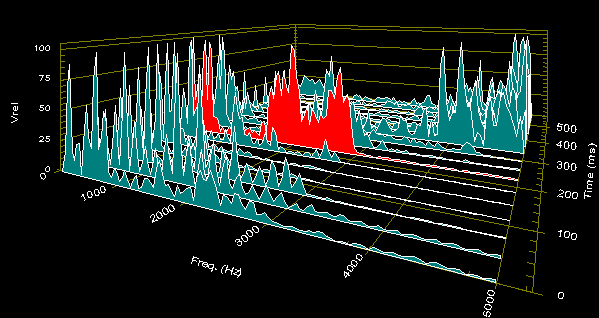
In analyser experiments you capture sound from the sound card or from a WAV file up to several seconds long, select the starting time of the time slice and analyse time and frequency responses. The example shows the spectrum of a piano playing a middle C (262 Hz). The non-harmonic overtones are clearly seen. (Due to the stiffness of the string, the frequencies of the partials are too high.)
Download version 1.15, June 2009: OVERTONE.ZIP
(1.55 MB)
Unpack in a new folder, read README.TXT and start OVERTONE.EXE
(Some firewalls or User Access Control (UAC) may block execution. Give OVERTONE the necessary permissions.
Make sure, that the sound device is not used by another application.)
For more information, send e-mail to address given in README.TXT
Unterrichtseinheit Analyse von Klangspektren von Alain Hauser (in German)
