Midi //top\\ | Mini2sf To

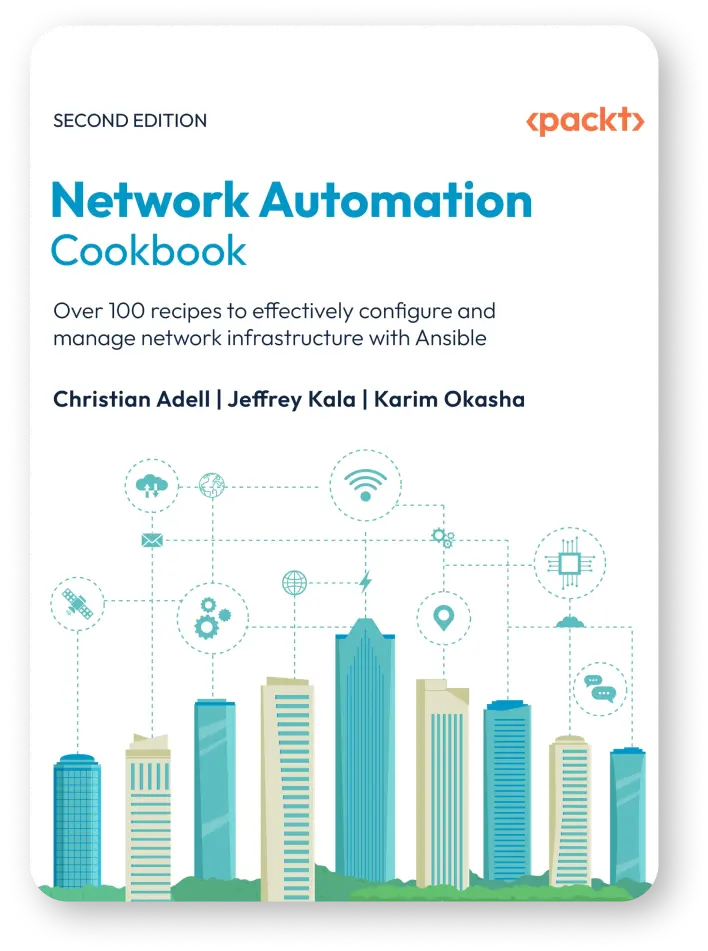
Over 100 recipes to effectively configure and manage network infrastructure with Ansible
By Christian Adell, Jeffrey Kala, Karim Okasha

mini2sf to midi mini2sf to midi

Book Description

Network Automation Cookbook, now in its second edition, is your essential guide to building robust network automation workflows across modern hybrid infrastructures. Building on the foundation laid in the first edition, this version dives deeper into Ansible’s role in automating network infrastructure, expanding coverage to include modern use cases across enterprise and cloud networks. The book introduces Ansible’s core concepts such as playbooks, inventories, variables, loops, templates and progresses to advanced topics like parallelism, fact caching, custom filters, and modular design. You will automate real-world scenarios using Nokia SR, Cisco IOS, Juniper, and Arista devices in a fully reproducible virtual lab. It also explores cloud automation for AWS, Azure, and Google Cloud, and integrates validation tools like PyATS, Batfish, and Nautobot. New chapters cover event-driven automation, AWX for workflow execution, and Terraform integration. Whether you’re a network engineer, DevOps pro, or cloud architect, this book equips you with the tools and workflows to automate infrastructure efficiently with Ansible.

Who is this book for?

This edition helps readers understand Ansible’s role in network automation and how it integrates with tools like Terraform and event-driven architectures. With hands-on labs and fully reproducible recipes, readers can practice real-world scenarios and reinforce their skills. Ideal for network engineers, automation engineers, and NREs, the book requires basic networking knowledge and familiarity with YAML to maximize learning. mini2sf to midi

What you will learn

  • Build Ansible playbooks, roles, and inventories from scratch
  • Automate Cisco, Juniper, Arista, and F5 network devices
  • Deploy cloud networks on AWS, Azure, and Google Cloud
  • Validate networks with Batfish, PyATS, and NAPALM
  • Use AWX for workflow automation and job scheduling
  • Integrate NetBox or Nautobot as dynamic inventory sources
  • Run all recipes in containerized, hardware-free labs
  • Apply event-driven automation using Ansible Rulebooks

NAC Book

explore other books written by NTC

Explore Books
ntc img
ntc img

Contact Us to Learn More

Share details about yourself & someone from our team will reach out to you ASAP!

Midi //top\\ | Mini2sf To

The mini2sf file format is used to store sound fonts, which are collections of audio samples used to generate sound in synthesizers. These sound fonts contain a set of sounds, each with its own characteristics, such as pitch, volume, and timbre. The mini2sf format is commonly used in mobile devices, such as smartphones and tablets, for generating sound in music and games.

Converting mini2sf to MIDI can be a useful process for musicians, producers, game developers, and archivists. While there are challenges and limitations to consider, various tools and software applications are available to facilitate the conversion process. By understanding the mini2sf and MIDI file formats, as well as the conversion process, individuals can unlock new creative possibilities and make their sound fonts more accessible and versatile.

The mini2sf and MIDI file formats are two distinct types of audio files used in different contexts. mini2sf is a file format used for storing sound fonts, which are collections of sounds used in synthesizers, while MIDI (Musical Instrument Digital Interface) is a protocol for controlling and communicating with musical instruments. In this write-up, we will explore the process of converting mini2sf to MIDI, the tools required, and the potential applications of this conversion.